
Searching Live Oak County Civil Dockets
District civil and family matters start with the Live Oak County District Clerk. The office identifies personal injury, contract, property, divorce, parent-child, and Attorney General matters within its district record scope. re:SearchTX is the state electronic search route, but access can depend on registration, role, case type, and current local integration.
Gather the court name, exact cause number, case style, approximate filing date, and desired record type. A cause number is usually more precise than a party-name search.
- Identify the court from a pleading, notice, or prior order.
- Search re:SearchTX by exact cause number, then try style and date filters.
- Separate the case detail from filing and hearing results.
- Contact the proper clerk by phone or at the counter when no result appears.
- Request inspection or a regular or certified copy with a clear date range.
Live Oak County Civil Clerk Routes
Live Oak County has a split clerk system. The District Clerk keeps district civil and family files and serves the 2nd Multicounty Court at Law according to the county page. The County Clerk handles constitutional County Court, probate, guardianship, and county records. Justice Courts keep their own small-claim, eviction, and other precinct-level civil records. Picking the wrong clerk can produce a no-result answer even when the case exists.
| Civil matter | Starting custodian | Useful detail |
|---|---|---|
| District civil or family | District Clerk | Court and cause number |
| Probate or guardianship | County Clerk | Estate name and filing year |
| Small claim or eviction | Correct Justice Court | Precinct and case number |
| Land instrument | County Clerk PublicSearch | Document or grantor/grantee data |
The last row is an official-record route, not the lawsuit docket itself.
Inside a Live Oak County Civil Docket
A civil docket organizes events in date order. It may identify the court, cause number, case style, case type, parties and roles, filing date, pleadings, service, hearings, orders, and judgment. No public Live Oak County sample was exposed during research, so these are a supported field inventory rather than a claim that each field is open in every case or portal view.
| Cause number | The exact retrieval key; keep its punctuation and suffixes. |
|---|---|
| Case style | The caption used to distinguish the parties and matter. |
| Filings | Petitions, answers, motions, exhibits, notices, and orders when public. |
| Settings | Scheduled hearing or trial events that may later reset or change. |
| Judgment | A final order, dismissal, or other outcome; read the document for context. |
Live Oak County Civil Search Limits
The County Clerk links to PublicSearch, but the visible department is Real Property. Its fields cover a search term, recorded-date range, quick date choices, and index-only or index-plus-OCR searches. Those tools can locate deeds, liens, and recorded instruments. They do not constitute a district civil docket or probate case index.
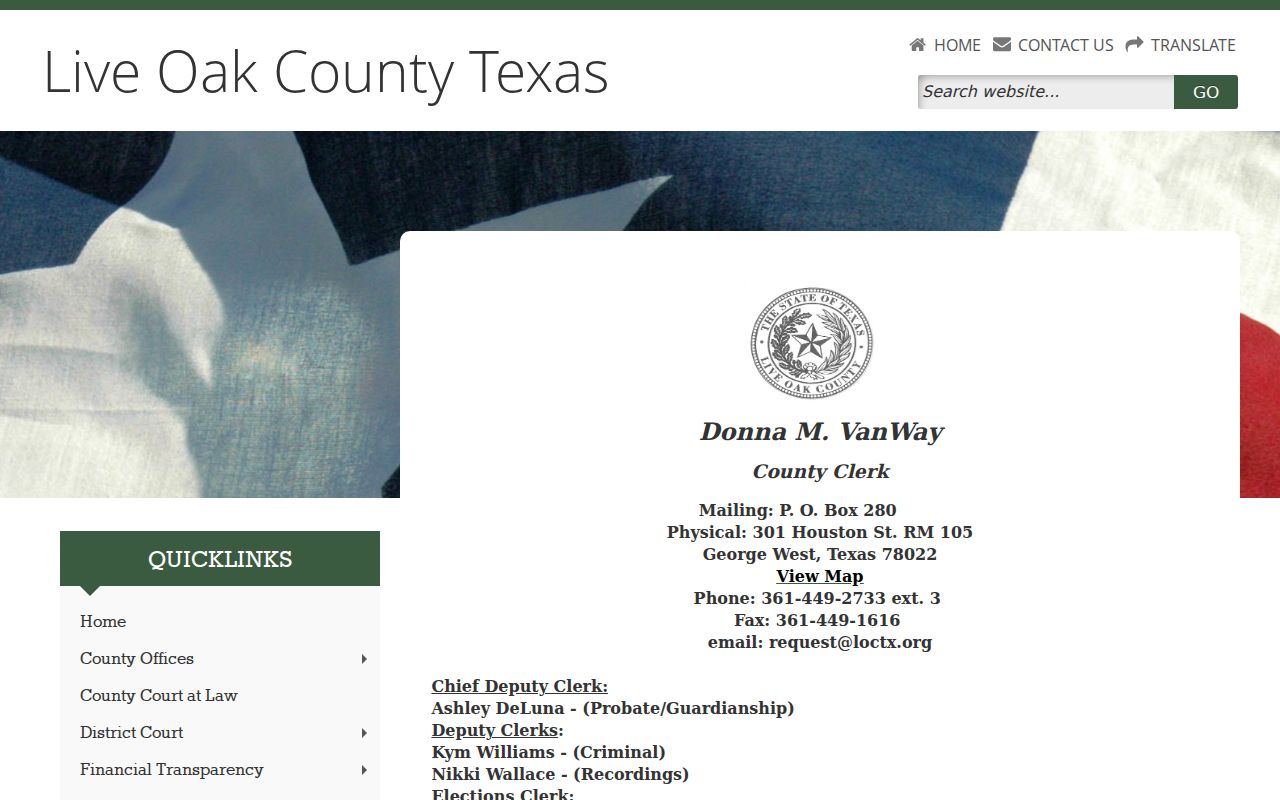
The official County Clerk page provides the local source for this distinction and the office's public record services.
A land instrument may be evidence in a lawsuit while the lawsuit's pleadings and hearings remain with the court clerk. Search each collection for the record it actually holds.
The PublicSearch interface pictured here shows the Real Property department and its term, date, index, and OCR controls.
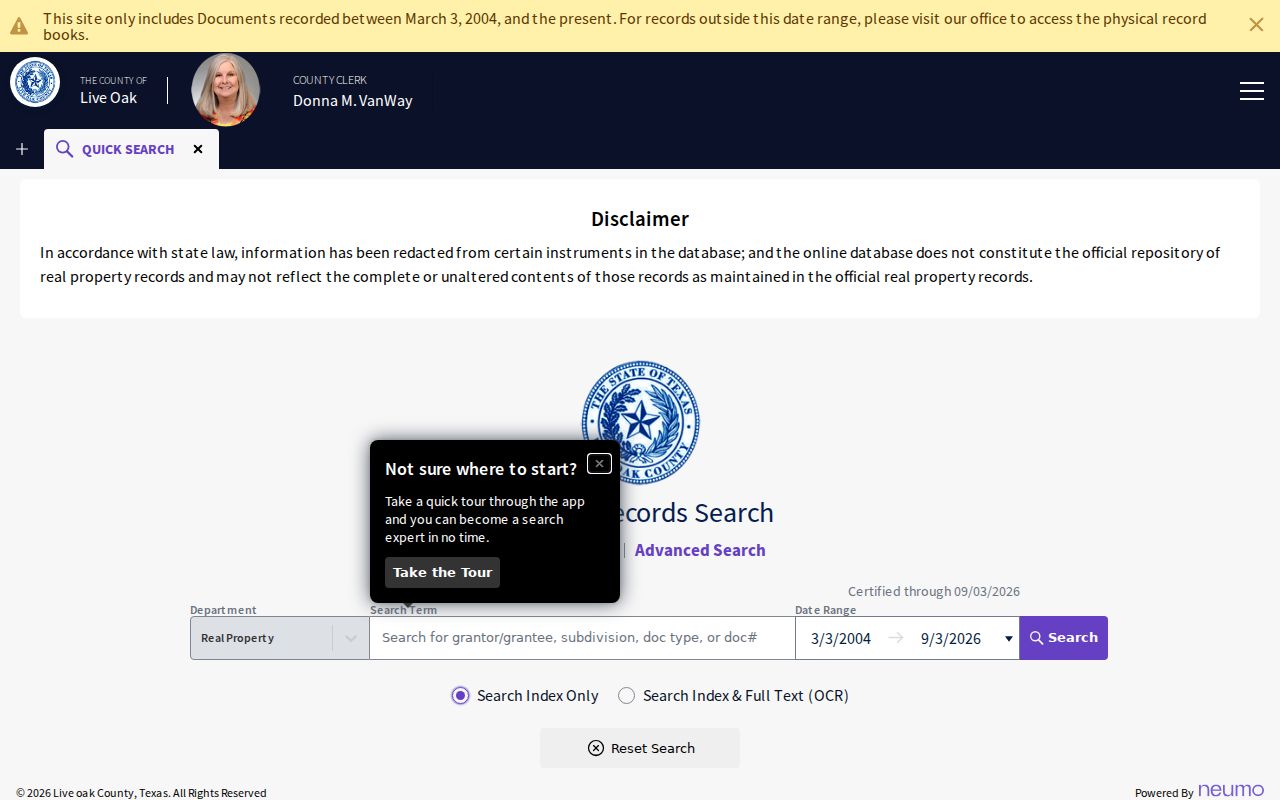
Its department label is the key warning: the screen is useful for recorded instruments, not a general Live Oak County civil case register.
Civil Case Types on the Docket
Live Oak County civil records span several jurisdictions. District records include broad civil and family matters, while probate and guardianship route through the constitutional County Court and County Clerk. Justice Courts maintain their own lower-dollar civil, small-claim, and eviction matters. The case type and named court determine the search route.
- Personal-injury, contract, and property disputes in district court
- Divorce, parent-child, and Attorney General matters
- Probate and guardianship proceedings routed to the County Clerk
- Small claims and eviction matters in the proper Justice Court
- County-level civil matters assigned to the named county court
Some family, minor, medical, and financial information may be restricted even when a case number or event remains public.
Live Oak County Civil Divorce Access
The District Clerk expressly documents a public terminal for divorce searches. That is the clearest local evidence of in-person electronic civil access. The county page tells a person who cannot visit to call the office. It does not promise remote downloads, all pleadings, unrestricted copies, or a countywide terminal for every case type.
Live Oak County District Clerk
Room 202, 301 Houston Street
George West, TX 78022
361-449-2733 ext. 2
DCOFFICE@loctx.org
P.O. Box 440, George West, TX 78022
Before visiting, ask whether the terminal covers the target year and case type, whether inspection is available, and what charge applies to regular or certified copies. The clerk says filings are not accepted by email, fax, or mail, which is separate from asking for a record.
Civil Docket Settings and Hearings
A setting is a scheduled appearance, conference, hearing, or trial. A calendar entry does not prove that the event occurred. A later reset, continuance, cancellation, or amended scheduling order can change the date or purpose. Confirm the latest Live Oak County civil setting with the clerk and the notice issued in the case.
re:SearchTX materials describe a Hearings search mode and hearing detail, but availability can vary by court and user role. The county's appointments-and-fees archive is an administrative report collection, not a hearing calendar. For a focused scheduling workflow, use the Live Oak County court dates resource and still verify the actual notice.
Note: A docket date can be the filing date, event date, or entry date, so read the column label before building a timeline.
Live Oak County Civil Filing Systems
eFileTexas handles electronic filing and service, while re:SearchTX is the electronic case-record search environment. Attorneys must electronically file in listed civil, family, probate, criminal, and appellate courts, and non-attorney filing is encouraged. A successful submission is not the same as public docket access because clerk review, acceptance, and access rules still control the case record.
| System | Main task | Does not prove |
|---|---|---|
| eFileTexas | Submit or serve a filing | That the document is public or accepted |
| re:SearchTX | Search available cases, filings, and hearings | Complete access for every Live Oak case |
| PublicSearch | Find recorded real-property documents | A civil lawsuit docket or probate index |
Use the system whose stated purpose matches the task.
Civil Docket Access Rules
Public civil docket information can coexist with sealed or redacted documents. Texas rules protect sensitive identifiers such as Social Security and tax numbers, financial accounts, birth dates, home addresses, and a minor's name in covered filings. Medical, family, guardianship, and other protected material may also face limits. Report a document as sealed or restricted only when the court or clerk shows that status.
Key Rules:
Texas Judicial Branch open-records policy distinguishes Rule 12 judicial records from ordinary agency records.
Texas Government Code Chapter 552 contains judiciary provisions and court-record exceptions.
Current Texas court rules provide the governing source for sensitive-data and civil-sealing procedures.
A requester should identify the existing record clearly. Rule 12 does not require a custodian to create a new report, retain a record for a new period, or provide commercially available information without charge.
Live Oak Civil Docket Copies
A portal result helps identify a case, but a clerk copy is the route when an authenticated judgment or filed pleading is required. Ask the clerk who holds the case, not the office that happens to host a related land document. State whether the request seeks inspection, an ordinary copy, or a certified copy and include the court, cause number, document title, and date range.
The County Clerk publishes $1 per page for regular copies and $5 certification plus $1 per page for records within that office's custody. Those amounts should not be applied automatically to District Clerk civil records. The District Clerk says its fees are statutory and should be confirmed for the precise service. Mailing, certification, redaction, and research needs can affect the response.
For a missing online case, call the correct clerk, ask about the index and inspection method, then record the date searched. A certified copy comes only from the custodian of the original file.